About Microbio551
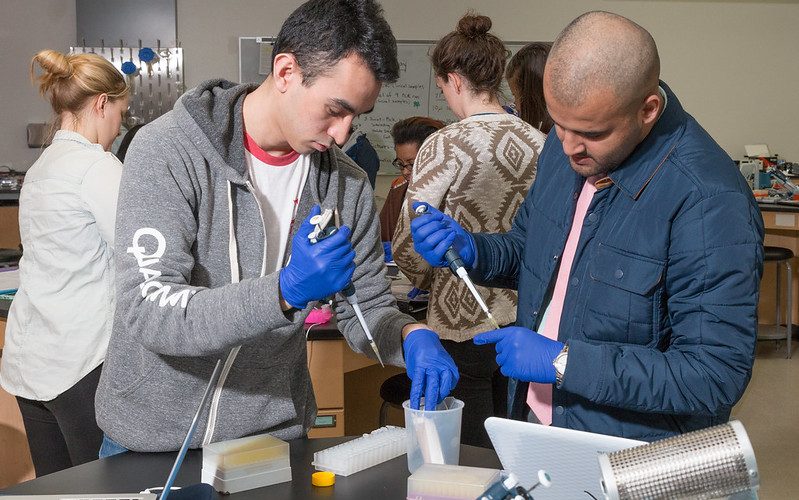
Micro551 is a capstone lab class that is intended to mimic a research lab setting. Students explore the diversity of a specific environment using culture-dependent and culture-independent techniques and generate new, publishable data. There are no protocols given, only a list of equipment and reagents that are available to the students. The students find protocols on their own while working in teams. It is also a ComB class, where students get feedback on written and oral communication.
Larger Course Goals:
This capstone research class will encourage students to explore the diversity of microbiota in specific environment, isolate previously uncultured organisms, sequence the microbiome or the genomes of newly cultivated microbes, and test genomic predictions using bench experiments all while developing teamwork, resourcefulness, troubleshooting, oral and written scientific communication, scientific ethics, and an appreciation for the significance of Microbiology on the UW-Madison campus.
Learning outcomes: Hard skills
- Students will pass proficiency tests in molecular microbiology involving bacterial culturing, PCR, gel electrophoresis, Sanger sequencing, DNA quantitation, analytical micropipetting, and BLAST analysis.
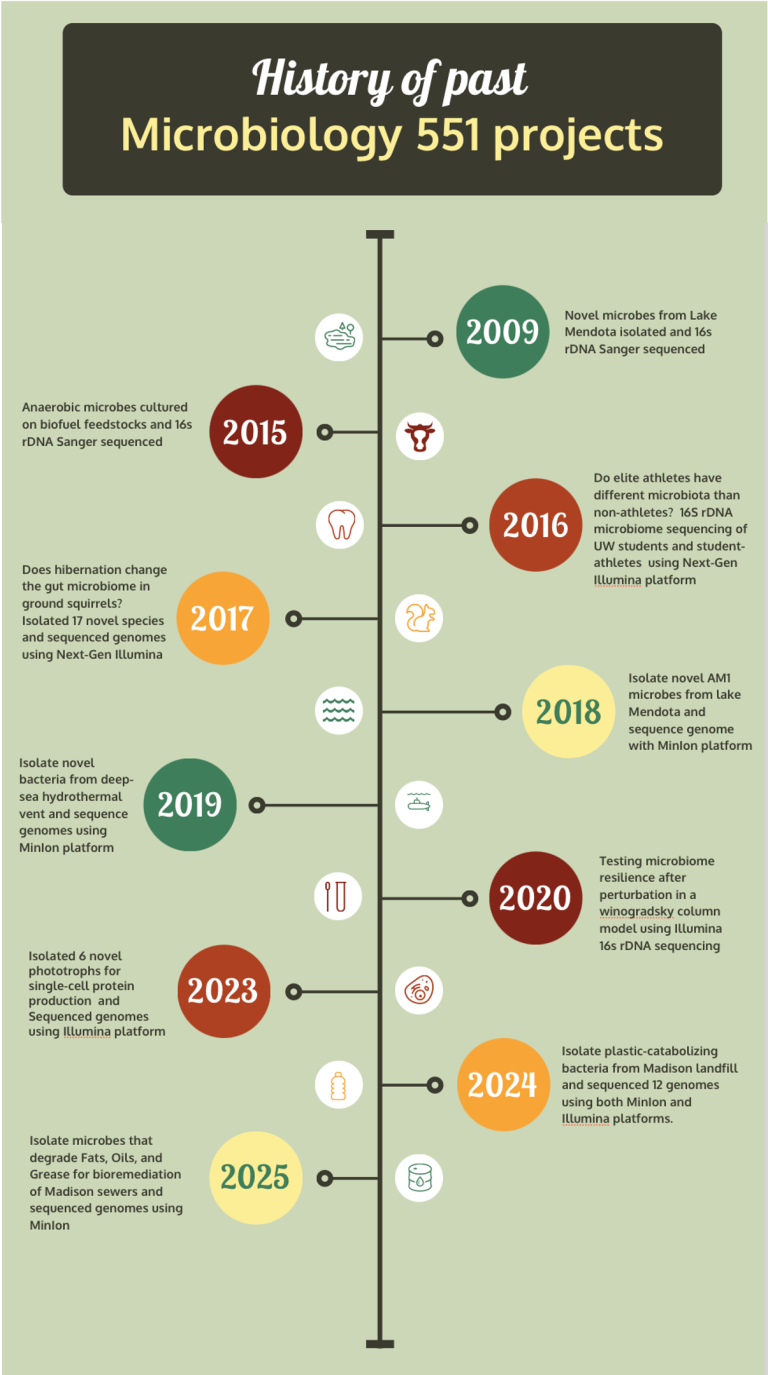
- Students will complete a next-generation or genomics sequencing project on an under-studied microbial environment.
- Students will use bioinformatics tools to analyze large datasets of DNA and/or RNA sequence.
- Students will design and troubleshoot experiments isolate targeted microbes or microbial groups from a given environment.
Learning outcomes: Soft skills
- Students will cultivate their ability to work in teams by designing and troubleshooting a team experiment and presenting their progress and findings throughout the semester.
- Students will improve scientific writing by preparing and revising drafts of a research proposal.
- Students will improve oral scientific communication by presenting powerpoint, chalk talk, and poster presentations on scientific research.
- Students will explore ethical dilemmas in science through writing, discussion, and case studies.
- Students will be able to discuss the history and significance of microbiology on the UW campus.
Our Mission
Real-world research projects in undergraduate classes retain students in the sciences and enhance student learning while addressing the most pressing challenges of our century.